
Hydraulic Goods Elevators
Oil-hydraulic goods lifts for low-rise buildings — strong, smooth and simple to install with minimal overhead structure.
Free site survey · Written quote in one working day
- 01500 kg to 5,000+ kg rated load
- 02No overhead machine room required
- 03Up to 15 m travel, 0.15–0.5 m/s
Hydraulic Goods Elevators: working principle & applications
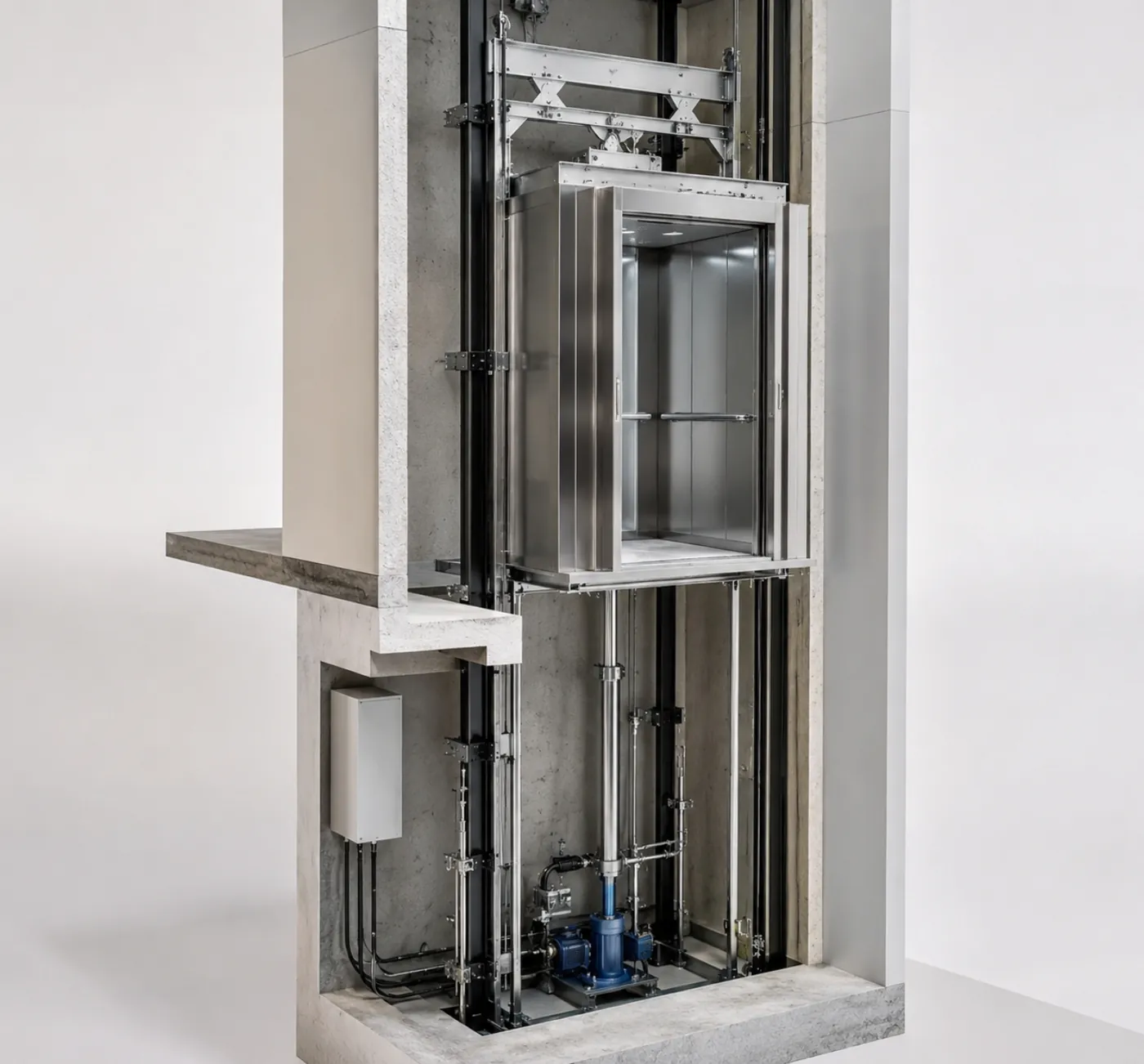
A hydraulic goods elevator lifts the car with a ram driven by oil from a pump unit. A motor-driven pump pushes oil into the cylinder to raise the car; a controlled valve releases it to lower the car under gravity. Because the lifting force comes from the cylinder, the building does not have to carry a heavy overhead machine.
This makes the system especially suitable for low-rise buildings and retrofits where headroom is limited or the roof cannot take machine loads. The power pack sits in a small room beside the shaft, and the smooth, shock-free starts protect fragile goods as well as the structure.
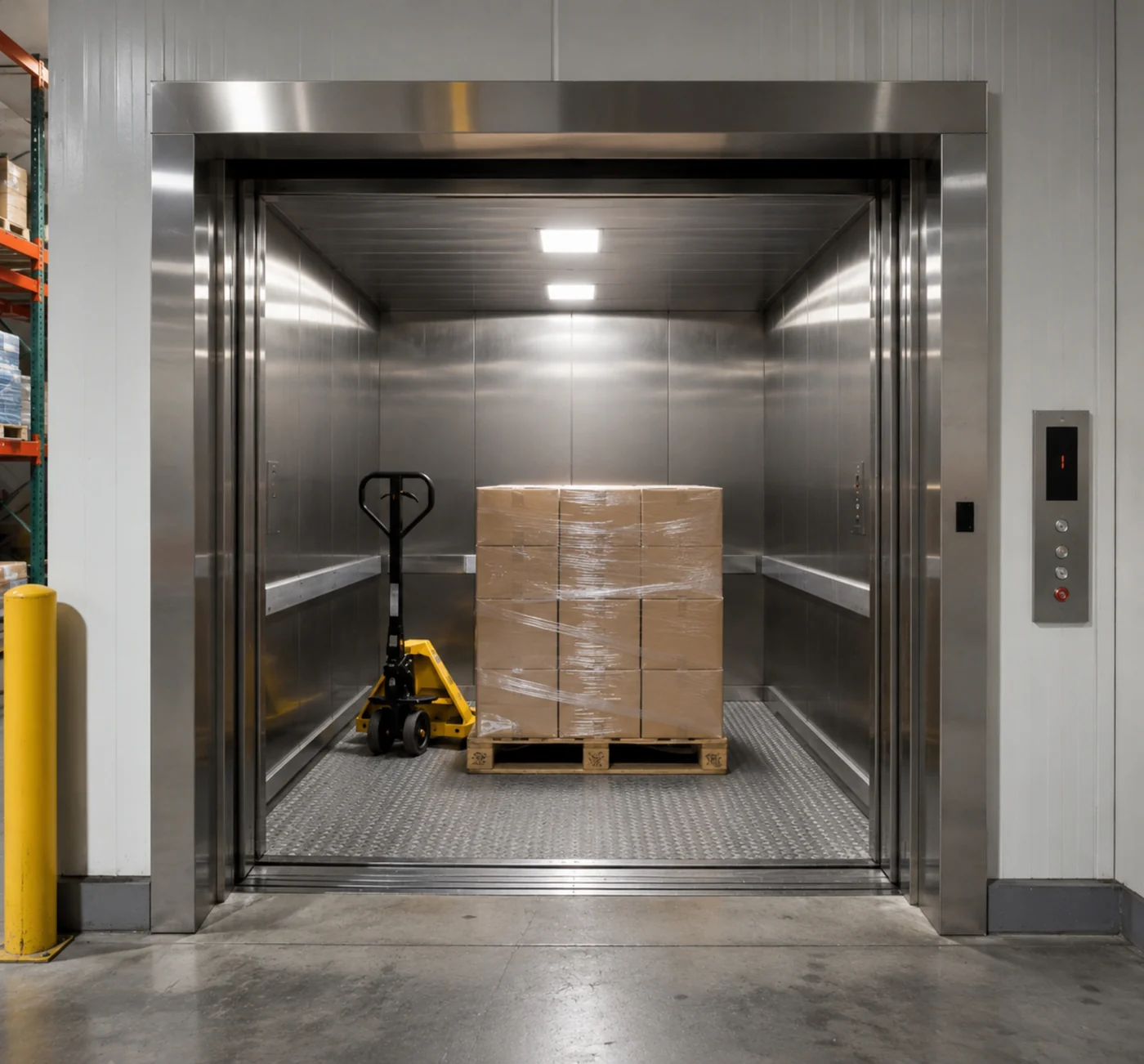
Duty is typically heavy and infrequent — vehicle-height lifts, machinery, stock moved between a basement and ground floor. Direct-acting or roped-hydraulic layouts, a rugged steel car and an emergency lowering valve keep the lift working and recoverable when power fails.
Workshops, showrooms, godowns, parking and loading bays, restaurants and low-rise factories.
What you get
Space-saving design
No overhead machine room; power pack can sit beside the shaft or in the pit area.
Very high load capacity
Cylinder drive handles 5,000 kg and above without oversizing the building structure.
Smooth hydraulic motion
Soft acceleration and controlled deceleration protect fragile and palletised goods.
Heavy-duty construction
Welded steel car, rail-guided platform and protected cylinder assembly.
Fail-safe lowering
Manual emergency lowering and pipe-rupture valve bring the car down safely.
Simple maintenance
Few moving parts and a compact pump unit make servicing straightforward.
Hydraulic Goods Elevators at a glance
| Parameter | Specification |
|---|---|
| Capacity / rated load | 500 kg to 5,000+ kg |
| Rated speed | 0.15 m/s to 0.5 m/s |
| Drive system | Oil hydraulic: direct-acting or roped-hydraulic cylinder with submersible or dry pump unit |
| Operation / control | PLC or microprocessor; push-button or key-switch operation |
| Door types | Manual collapsible gate · Imperforated swing door · Vertical-lift door (power operated) |
| Cabin finishes | Mild steel powder coated · Stainless steel (optional) · Chequered plate floor |
| Car & shaft size | Platform and pit sized to load; dimensions fixed after site survey |
| Travel & stops | Up to 15 m travel and 4 stops in standard configuration |
Values are typical and customisable. Final capacity, speed, dimensions and finishes are confirmed after the site survey and approval drawing.
Safety is never optional
- Governor & safety gear
Over-speed governor with progressive safety gear stops the car on the guide rails if it exceeds rated speed.
- Overload sensor
Load-weighing device prevents departure and sounds a buzzer when the rated load is exceeded.
- Interlocked doors
Landing doors are mechanically and electrically interlocked, so the car cannot move with any door open.
- Emergency alarm & lighting
Battery-backed alarm bell and emergency light keep users reassured and visible during a power cut.
- Final limit & buffers
Terminal slowdown, final limit switches and oil or spring buffers protect the pit and overhead.
- Pipe-rupture valve & emergency lowering
A rupture valve prevents free fall if a hose fails; a manual lowering valve brings the car down during a power cut.
Questions we get asked
When should I pick hydraulic over traction?
Choose hydraulic for low-rise buildings, heavy loads and limited headroom. Choose traction for frequent use, higher speeds and taller travel.
How high can a hydraulic goods lift travel?
Standard configurations serve up to about 15 m. Beyond that a traction lift is usually more economical.
What happens in a power failure?
The car stays safely at its position and can be lowered to the nearest landing using the manual emergency lowering valve.
Request a custom quote for hydraulic goods elevators
Our engineer measures the site, confirms load, travel and power supply, then puts a written quote in your hands within one working day. No obligation, no call centre.
- Survey booked within 48 hours
- Civil work, power and lead time stated up front
- Installed and serviced by our own team
Related products
Goods Elevators
Rugged goods lifts from 500 kg to 5,000 kg for factories, godowns and workshops.
ExploreFreight Elevators
Heavy-duty freight lifts built for pallets, forklifts and industrial uptime.
Explore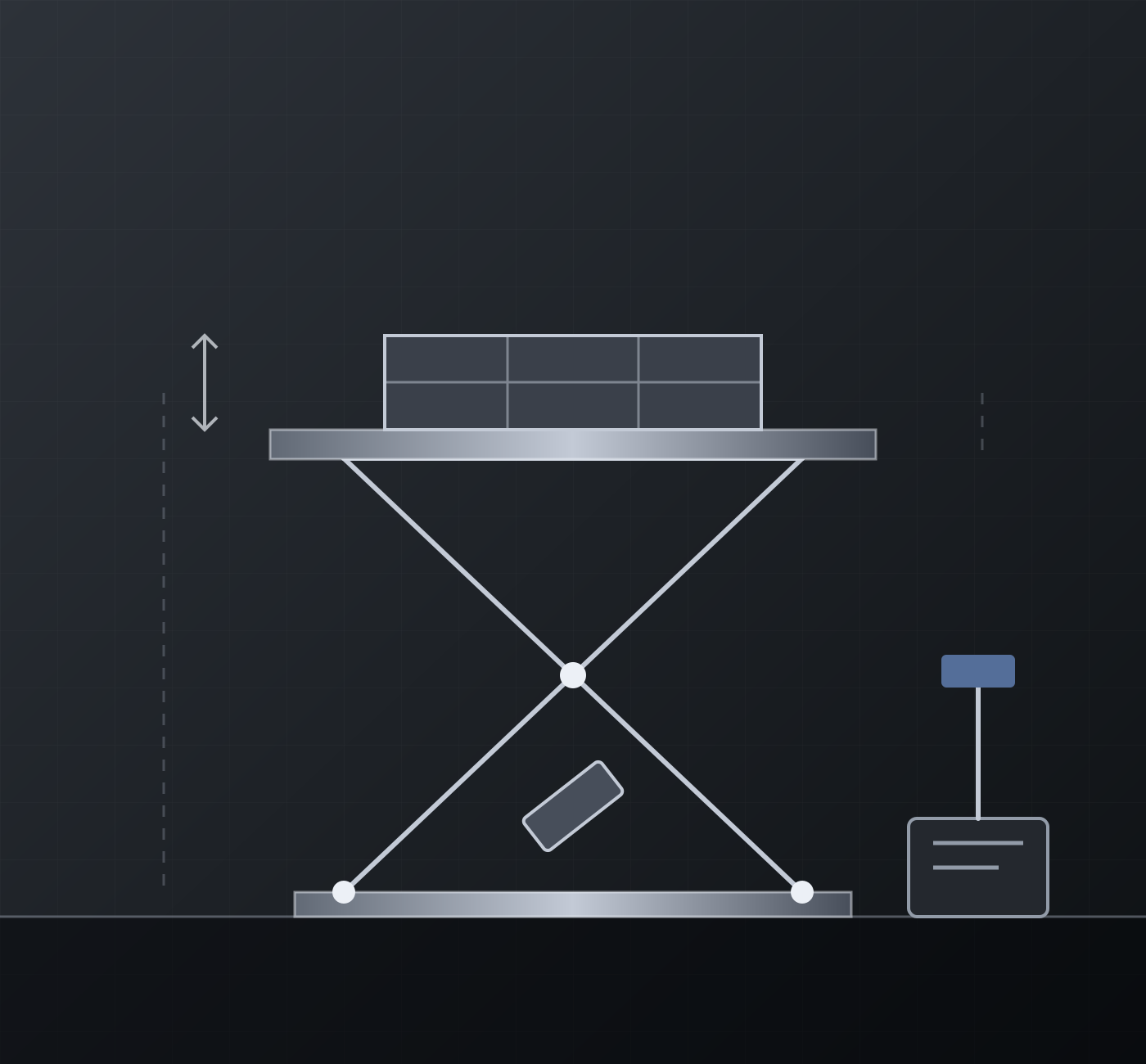
Hydraulic Fixed Stacker
Compact hydraulic platforms for lifting pallets and material between levels.
Explore